
The joint statement issued after Prime Minister Narendra Modi and President Barack Obama's first-ever summit is high on intent and ambition. Notably missing from the statement is India's refusal to be America's partner in its war against ISIS.

When a Chinese warship entered Japanese waters, the Indian commander called on China to maintain discipline at sea. Dr Rajaram Panda explains the significance of the Malabar exercises between India, Japan and the US.

'A participant in many rounds of the border talks with China once told me that China seemed not interested in resolving the border issue as it wanted to keep it as a ready excuse to intervene in the sub-continent,' says Colonel (retd) Anil A Athale.
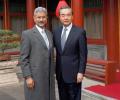
India on Wednesday hit out at China for demanding "solid evidence" for getting Jaish-e-Mohammed chief Masood Azhar banned by the United Nations

The developments in Af-Pak region, particularly the fall out of Pak political paralysis, would make President Xi Jinping's task a little more complicated, says Colonel R Hariharan.
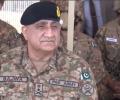
The chief of the army staff said that with one-third of the world in the Gulf region and elsewhere involved in some sort of conflict and war, "it is important that we keep the flames of fire away from our region."

The meeting, which comes after the Doklam standoff, is aimed at a working a new paradigm for the bilateral relations for the next 15 years.

'Both Modi and Xi know that if all that there is to show for Modi's visit -- barely eight months after Xi's India trip -- is a repeat of the same old declarations, there will be a terrible sense of letdown in the public mood resulting in future summits losing credibility. Only the possibility of new ground being broken can justify Modi's trip at this time,' says B S Raghavan.

Notwithstanding the strain in ties, the navies of India and China carried out a well coordinated operation to rescue a merchant ship in the Gulf of Aden which was hijacked by Somali pirates on Saturday night.

Japan's Mima Ito took the bronze medal after beating Han Ying of Germany in straight games.

India and China on Friday agreed to seek a "political" solution to the border dispute at the earliest as Prime Minister Narendra Modi asked Beijing to "reconsider its approach on some issues" and announced CBMs like e-visa for Chinese tourists and operationalisation of hotline between two militaries.

The people will view it from their viewpoint, their immediate interest, historical experiences, their insecurities, he said.

According to the Dawn, Pakistan submitted its membership application on May 19, a week after India, which applied on May 12.

'By the time he came out after nearly five hours, he had a one-to-one conversation with the President, a delegation-level meeting, a reception, a dinner, a tour of the White House and a joint statement of a kind none of his predecessors ever had,' says Ambassador T P Sreenivasan.

It is the first meeting between the two leaders after India boycotted the high-profile Belt and Road Forum.

Prime Minister Narendra Modi has met his Australian counterpart Scott Morrison in Washington, DC, ahead of the first in-person Quad meeting to be hosted by US President Joe Biden and discussed a broad range of issues of bilateral, regional and global importance, including the Indo-Pacific.

He warned that Pakistan-supported terrorist groups would continue to carry out attacks inside India.

President Biden underscored that the United States will 'continue to stand up for its interests and values and, together with our allies and partners, ensure the rules of the road for the 21st century advance an international system that is free, open, and fair', the White House said in a readout of the meeting.

If the aim is to become a player with some strategic space of its own, not just in the Indian Ocean region but also in the adjoining region, then greater interaction with China is desirable, even necessary.

'India's military posture has become significantly stronger than China's on the 3,500-kilometre Line of Actual Control.' 'This is enhancing confrontation between the two sides,' points out Ajai Shukla.

Modi's arrival has changed the optics of the visit. There is a different demonstration of the confidence level in the Indian leadership, but not much has changed beyond that, reports Sheela Bhatt/Rediff.com.

The reversal of Trump's policy with regard to Iran, like the withdrawal from the Paris Agreement, may not be a matter of just turning the clock back, but one of patient negotiations, with uncertain consequences in the post-COVID-19 world, observes Ambassador T P Sreenivasan.
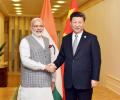
The meeting, which lasted for nearly 50-minutes, comes in the backdrop of stiff Chinese opposition to India's entry into the NSG, which looks after critical issues relating to nuclear sector, including trade and export of nuclear technology.

Rediff.com's Sheela Bhatt, who is accompanying Prime Minister Manmohan Singh on his trips to Russia and China, notes that Moscow and New Delhi work together professionally and via a shared common approach on crucial issues.

Even as the United States snuggles closer to India with the thinly veiled objective of containing China, the Indian strategy is to avoid alienating either nation.

'Whether it's investments in Kashmir, building naval facilities, or selling top-of-the-range military equipment, Pakistan could well benefit more under Xi's watch.' 'Do Chinese concerns about the 'Islamisation' of Pakistan give it pause about how quickly to move forward with security and economic projects? At the moment the indication is quite the opposite: China is doubling down on its support to Pakistan, partly because of its fears about where the country is headed.'

'The clean break between Russia and Europe that this foolish attack is creating may actually last long.' 'It will undermine Europe and benefit the US and China.'

Macron held a tete-a-tete with Modi before the delegation-level talks at the Elysee Palace - the official residence of the French president.

Prime Minister Narendra Modi's visit will highlight the growing collaboration between India and the US and their "shared leadership" on the world stage, the White House said on the eve of his arrival.
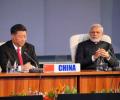
'Modi's finest political legacy ought to be a border settlement with Beijing,' asserts Ambassador M K Bhadrakumar.

The beauty of the relationship between the two countries is that they agree to disagree and perhaps that is the strongest bond between the two governments and their relationships, notes Rup Narayan Das.

Now, as before, India's vote at the UN was dictated by paramount national interests. Though the Indian vote was 'neutral', its explanation was explicit in its criticism of the Russian actions. India took back with the left hand what it had given with the right, explains Ambassador T P Sreenivasan.

The world is seeing an "explosion" in seizures of power by force and military coups are back, UN Secretary General Antonio Guterres told world leaders on Tuesday, lamenting that geopolitical divisions are undermining international cooperation as he called for strengthening global governance and re-igniting multilateralism.

The sources said the military brass is considering deploying Indian Navy's MiG-29K fighter jets in a couple of air bases in the northern sector as part of efforts to bring in tri-services synergy in dealing with national security challenges.
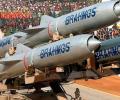
'Pakistan was very mature in the way it dealt with the incident.' 'India too owned up to the accident.' 'The whole incident was resolved quite amicably.' 'Both countries should be proud of how they have handled this situation.'

The Biden administration is quietly pressing Pakistan to cooperate on combating dreaded terrorist groups such as the ISIS-K and Al Qaeda following the Taliban takeover of Afghanistan, according to a set of leaked documents and diplomatic cables to a prominent US media outlet.

The foreign secretary said almost all major initiatives of India in SAARC did not fructify due to hurdles posed by Islamabad.

Possible US envoy says India must get assurance against China.

In bilateral interfaces relations with China have also to be given due weight, opines Premvir Das

Rajaram Panda explains why the US president needs to restrain himself and build a relationship with China to put any credible pressure on North Korea.
 © 2026 Rediff.com - Advertise with us - Disclaimer - Privacy Policy - Sitemap - Feedback - About us - Terms of use - Grievances